
LEAK RISK
Tank Leaks
Active leaks may indicate liner failure, laminate cracking, nozzle stress, gasket failure, or localized chemical attack.
Inspection Priority
EST. 1988
OSHA COMPLIANCE
CONFINED SPACE
CERTIFIED TECHNICIANS
ISO 9001
CERTIFIED COMPANY
We repair Fiberglass (FRP) Above Ground Storage Tanks (AST) or highly regulated Underground Storage Tanks (UST), to prevent severe environmental and operational liabilities.
We utilize advanced composite engineering to repair cracks, reinforce structural integrity, and apply specialized chemical-resistant liners, often completing the work in a fraction of the time and cost of a full tank replacement. OSHA Compliant, Confined Space Certified.
Structural bottom replacement & patching.
Chemical-resistant interior resin relining.
Exterior UV degradation repair & coating.
Industrial fiberglass tanks often fail gradually before they fail visibly. Leaks, cracks, delamination, blistering, soft laminate, chemical attack, worn interiors, nozzle stress, and failed prior repairs can all indicate that the tank’s corrosion barrier or structural laminate needs evaluation.
Plastech inspects the damage, identifies the likely cause, and recommends whether localized repair, relining, modification, or replacement review is the appropriate next step. Before repairing or relining a Fiberglass tank, we perform a pull test to ensure material compatibility.
LEAK RISK
Active leaks may indicate liner failure, laminate cracking, nozzle stress, gasket failure, or localized chemical attack.
Inspection Priority
STRUCTURAL RISK
Cracks can form from impact, stress, movement, pipe loads, chemical exposure, or aging laminate.
Repair Candidate
LAMINATE DAMAGE
Delamination occurs when fiberglass layers separate, reducing structural continuity and chemical containment reliability.
Structural Risk
SURFACE DAMAGE
Blisters and soft laminate may indicate permeation, chemical attack, trapped moisture, or corrosion barrier breakdown.
Reline Candidate
CHEMICAL RISK
Incompatible chemicals, concentration changes, temperature, or extended exposure can degrade resin systems and interior liners.
Chemical Risk
LINER FAILURE
Worn or failed liners can expose the structural laminate to chemical service and increase the risk of leaks or tank failure.
Reline Candidate
CONNECTION STRESS
Leaks or cracks around nozzles and flanges often result from pipe loads, vibration, gasket issues, or flange misalignment.
Leak Risk
ACCESS POINTS
Manways can develop leaks, collar damage, cover issues, bolt-hole stripping, or laminate stress around access points.
Repair Candidate
WEAR AREA
Tank floors and low points can experience abrasion, sediment exposure, standing chemical attack, or laminate thinning.
Inspection Priority
EXTERIOR DAMAGE
Exterior fiberglass surfaces can degrade from UV exposure, weathering, coating failure, impact, or support-related stress.
Coating Candidate
PRIOR REPAIR
Incompatible patching, poor surface preparation, or incomplete repairs can fail and create recurring leaks or weak points.
Rework Candidate
STRUCTURAL DAMAGE
Structural laminate damage may require reinforcement, rebuild, relining, or replacement review depending on severity.
Structural Risk
From mobile transport tanker trailers to localized flanged nozzle failures, our crews deploy with the specialized materials and protocols required for above-ground storage (AST) and underground-storage (UST) tanks.
// UST
Confined-space certified teams executing internal retrofits, rib reinforcements, and primary containment restoration.
// MODIFY
Precision flanged nozzle repair and gusset reinforcement to prevent high-stress leaks at critical pipe junctures.
// RELINE
Specialized resin coating and structural mat layups to restore chemical resistance and extend operational lifespan.
These guys are always the first ones on the jobsite and finish anything they need to do in the shortest time possible and the work always turns out great. Smartest Contractors out there...
Plastech has exceeded all expectations. A Contractor we can always count to be on time, efficient, and produce quality work. Would definitely recommend for any job.
The safety mindset, quality, craftsmanship, and attention to detail of the Plastech team was above and beyond...They did not cut corners, and they completed the repair a day earlier.
Connect directly with our technical management team. Provide details about your project and facility requirements, and we will expedite a project review.
Rapid response for critical tank Failures.
Comprehensive project scope assessments.
Industry-leading safety & OSHA compliance.

Industrial fiberglass tanks often fail gradually before they fail visibly. Leaks, cracks, delamination, blistering, soft laminate, chemical attack, worn interiors, nozzle stress, and failed prior repairs can all indicate that the tank’s corrosion barrier or structural laminate needs evaluation. Plastech inspects the damage, identifies the likely cause, and recommends whether localized repair, relining, modification, or replacement review is the appropriate next step.
| Condition | Repair | Reline | Replacement Review | Notes |
|---|---|---|---|---|
| Localized crack or puncture | Yes | Sometimes | Rarely | Localized structural patching may be appropriate if surrounding laminate remains sound. |
| Nozzle or flange leak | Yes | Sometimes | Rarely | Repair may include nozzle reinforcement, flange repair, gasket surface restoration, or pipe-load correction. |
| Manway damage | Yes | Sometimes | Rarely | Manway collars, covers, bolt holes, and sealing surfaces can often be repaired or reinforced. |
| Interior liner deterioration | Sometimes | Yes | Sometimes | If structural laminate is still suitable, relining may restore chemical resistance and extend service life. |
| Blisters or soft spots | Sometimes | Often | Sometimes | Blisters and soft laminate may indicate permeation, moisture, or corrosion barrier breakdown. |
| Widespread chemical attack | Limited | Often | Yes | Severe chemical degradation may require full reline or replacement review depending on structural condition. |
| Structural deformation | Limited | Limited | Yes | Deformation can indicate structural compromise and should be evaluated before returning the tank to service. |
| Failed prior repair | Yes | Often | Sometimes | Failed repair material should be removed and rebuilt with compatible FRP repair methods. |
| Exterior UV degradation | Yes | Sometimes | Rarely | Exterior surface damage may require coating, resurfacing, laminate repair, or weathering protection. |
| Recurring leaks | Maybe | Often | Yes | Recurring leaks require root-cause evaluation before additional repair work is performed. |
EDUCATIONAL HUB
Watch how Plastech handles high-stress environments for emergency fiberglass tank repairs, and swipe through our interactive guide below to learn about our specialized capabilities, from stationary storage facilities to mobile tanker retrofits.
FIELD EXECUTION
Play the PlasTech tank repair field videoINDUSTRY TRUST
We've worked with the Maryland Department of the Environment (MDE), FRP Tanker Trailer Companies & MDOT, W.R. Grace, Pixelle, and hundreds of other industrial and commercial facilities to ensure compliance and extend tank longevity:
CORE SOLUTIONS
Over the past 37 years, fiberglass tank maintenance needs have risen fivefold. This can be attributed to the rapid growth of fiberglass-reinforced plastic tanks used in water works, industrial parks, waste management facilities, water storage, Pulp and Paper Mills, the Oil and Gas industry, and the Chemical Industry.
We offer total solutions for facility managers, and in a time of supply chain crises, our fiberglass services can be timely and cost-effective solutions.
AST SYSTEMS
Above-Ground-Storage (AST) or Stationary fiberglass tanks are vital for storing various industrial liquids, including chemicals and water.
Over time, these tanks can experience wear due to environmental factors and chemical exposure, leading to potential leaks and structural issues. Regular repair and maintenance are essential to ensure their longevity and prevent costly failures.
At PlasTech Services Inc., we specialize in comprehensive repairs, relines, and inspections. We provide Specialized Chemical Service of Bleach & Hypo Tank Relining.
UST SYSTEMS
When it comes to underground storage tanks (UST), we perform interior and exterior fiberglass relines and repairs, nozzle modifications, fitting plates, manway relines and repairs, and piping installations and repairs.
We partner with leading manufacturers such as Tanks Direct and Xerxes to ensure every fiberglass repair, liner, or modification meets stringent performance and safety standards.
MOBILE TRANSPORT
Fiberglass tankers are integral to the safe and efficient transport of various liquids, including chemicals and food-grade products.
Over time, exposure to corrosive substances and environmental factors can deteriorate the interior linings of these trailers, leading to potential contamination, leaks, and structural failures.
At PlasTech Services Inc., we specialize in comprehensive relining and repair solutions for fiberglass tankers, utilizing advanced materials and techniques to extend the lifespan of your equipment.
ACCESS POINTS
Manways are essential access points on fiberglass tanks, facilitating maintenance, inspection, and cleaning operations. Regular repair and maintenance of these manways are crucial to ensure safe and efficient tank operations.
Over time, factors such as chemical exposure and environmental conditions can cause wear or damage to manways, leading to potential leaks or structural issues.
At PlasTech Services Inc., we specialize in comprehensive fiberglass tank repair solutions, ensuring that your manways and tanks remain in optimal condition.
FLANGES & CONNECTIONS
Our goal is to restore structural integrity and chemical resistance to damaged or leaking nozzles. Over time, exposure to corrosive chemicals, pressure fluctuations, and mechanical stress can cause cracks, delamination, or joint separation at nozzle connections.
Our technicians utilize advanced fiberglass and resin systems engineered for compatibility with existing tank materials to ensure a seamless, long-lasting repair.
Whether it’s a chemical storage vessel, scrubber, or process tank, our fiberglass nozzle repair solutions are tailored to your operating environment.
Different fiberglass tank systems fail in different ways. Plastech evaluates the tank type, service environment, access requirements, laminate condition, chemical exposure, and repair objective before recommending localized repair, relining, modification, or replacement review.
Is the damaged area connected to or supporting piping? Yes, No, or Not Sure.
Is the tank currently leaking product? Yes, No, or Not Sure.
Can the tank be drained, cleaned, and isolated for repair? Yes, No, or Not Sure.
FRP tank failure is often caused by a combination of chemical exposure, mechanical stress, aging laminate, improper support, and service conditions. A visible crack or leak may be only the symptom. The root cause may be nozzle loading, chemical attack, liner failure, abrasion, thermal movement, or a prior repair that was not compatible with the tank’s service environment.
Thinning of the tank structure due to chemical attack, incorrect concentration, or temperature
Blistering, peeling, or cracking of internal protective layers exposing the substrate.
Degradation of the primary chemical resistance layer in FRP tanks.
Seepage caused by vibration, piping loads, gasket failure, or corrosion at connections.
Accumulation of heavy byproducts causing localized bottom corrosion and flow issues.
Blockages or damage to desiccant vents and critical openings.
Moisture entry reducing acid concentration and drastically increasing corrosivity.
Warped covers, stripped bolts, or corroded sealing surfaces.
Failures in surrounding basins, dikes, or interstitial spaces.
OUR FIBERGLASS TANK REPAIR PROCESS
A strict, 8-step industrial approach.
Tank contents, service temperature, prior repairs, inspection history, operating environment, and site requirements.
Evaluate leaks, cracks, delamination, blisters, nozzles, manways, fittings, laminate condition, and interior/exterior surfaces.
Determine whether the damage is related to chemical attack, pipe loading, impact, corrosion barrier failure, UV exposure, or structural fatigue.
Clean, grind, remove failed material, isolate damaged laminate, and prepare the surface for compatible repair.
Apply appropriate fiberglass reinforcement, resin systems, structural patching, or corrosion-resistant repair materials.
When required, restore the tank’s internal corrosion barrier or recommend relining if damage is more widespread.
Allow repair materials to cure properly and inspect the repair area before return-to-service planning.
Provide repair notes, maintenance recommendations, inspection needs, or future reline/replacement considerations.
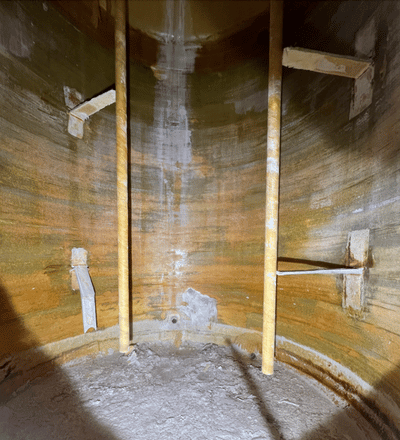
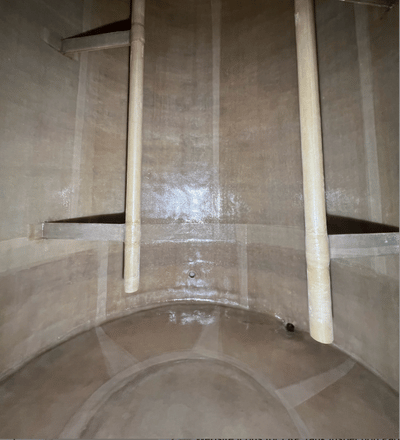
Drag the slider below to see how our fiberglass tank repair process can transform a severely compromised, chemically degraded fiberglass tank back to peak operational safety.
Depending on the tank type and application, relevant references may include:
ASME RTP-1 For reinforced thermoset plastic corrosion-resistant equipment used in storage or processing service.
ASTM D3299 for filament-wound FRP corrosion-resistant tanks used in above-ground chemical storage applications.
ASTM D4097 For contact-molded FRP corrosion-resistant tanks and related fabrication considerations.
ASTM D5421 For fiberglass flanges used in pipe systems and tank nozzle connections.
Manufacturer Requirements For tank-specific repair procedures, materials, limitations, and return-to-service expectations.
UST Regulations For applicable underground storage tank repair, relining, modification, and documentation requirements.
*Relevant standards vary by tank type, service environment, stored material, manufacturer requirements, and site-specific specifications. Plastech evaluates repairs in context rather than treating every tank failure the same.
Common questions regarding our repair protocols and timelines.
We've streamlined fiberglass tank repairs for the past 35+ years, including Pixelle Specialty Solutions, Chlorex, and hundreds more. What makes us different? We not only have dozens of years of experience in the industry, but we're also ISO 9001 certified. - We answer when you call. - We perform FRP repairs year-round. - We have the manpower to meet your critical scheduling needs. - We provide detailed inspections, scopes, and quotes. - We can perform additional mechanical needs, like chemical resistance protective coatings, plastic welding, and heavy industrial and commercial mechanical contracting. If you're a maintenance manager, driver for tanker trailers, or a facilities engineer get in touch with us!
Yes, we can perform above ground storage tank or underground storage tank fiberglass repairs. Whether your a chemical processing facility or local gas station in Maryland, we can repair, reline, and modify existing fiberglass tanks to maintain compliance and extend tank longevity.
Yes, Plastech offers emergency fiberglass tank repairs. Our field teams are equipped with mobile trucks, tooling, and materials to respond to your emergency tank repair needs. Have any emergency? Give us a call at 1-410-737-4700.
Whether bleach tanks, chlorine tanks, or water treatment tanks, Many FRP tanks can be repaired or relined when inspection confirms that a technically appropriate repair can restore the required integrity. We can also repair interstitial leaks.Our industrial maintenance company specializes in fiberglass tank repair and restoration. We also perform tank inspections and help our service partners by providing a guide to inspecting and maintaining FRP Tanks. We use the latest techniques and materials to ensure that your tank is repaired to its original condition. We have the expertise and experience to handle any tank of any size, from small to large. Our team of experienced technicians can repair cracks, chips, and other damage to your fiberglass tanks. We also offer fiberglass tank coating services to protect your tank from further damage. We guarantee satisfaction with our fiberglass tank repair services and work hard to ensure that your tank is restored to its original condition.
To fix a crack in a fiberglass tank, we use a combination of fiberglass resin and fiberglass cloth to fill and reinforce the crack. First, we'll perform an FRP Tank Inspection. Our experienced technicians begin by cleaning the area around the crack, then apply a layer of resin and cloth to the affected area. The resin is then allowed to cure and harden, creating a strong bond with the fiberglass tank. We use the highest quality materials to ensure that the repair is done properly and will last for years to come. With our expertise and attention to detail, you can trust that your fiberglass tank repair will be done right.
We emphasize a thorough inspection as the first crucial step in preparing for fiberglass tank repair. Before we arrive for a tank inspection, wether Above-Ground Storage Tanks or Underground Storage Tanks, we recommend taking the following steps for a smooth inspection. - Draining - Meticulously cleaning the tank Then, if any issues arise, we can provide detailed surface preparation and apply chemical-resistant materials for curing. We pride ourselves on selecting the right repair materials and methods, specifically tailored to each project's needs. This approach ensures effective, long-lasting repairs, showcasing our commitment to delivering high-quality, reliable fiberglass tank repair services. The resin is then allowed to cure and harden, creating a strong bond with the fiberglass tank. We use the highest quality materials to ensure that the repair is done properly and will last for years to come. With our expertise and attention to detail, you can trust that your fiberglass tank repair will be done right.
As a professional industrial maintenance company, we specialize in fixing holes in fiberglass tanks. We use a fiberglass repair kit to patch the hole, which includes resin and a hardener. First, we prepare the surface of the tank by sanding, cleaning, and drying the area around the hole. Then, we mix the resin and hardener according to the instructions and apply it to the hole, smoothing it out. After the resin has dried, we sand the area to make it even with the surface of the tank. Our experienced technicians are experts in fiberglass tank repair and can guarantee a strong, durable fix for any size hole (as long as the structural integrity of the tank is intact). - Draining - Meticulously cleaning the tank Then, if any issues arise, we can provide detailed surface preparation and apply chemical-resistant materials for curing. We pride ourselves on selecting the right repair materials and methods, specifically tailored to each project's needs. This approach ensures effective, long-lasting repairs, showcasing our commitment to delivering high-quality, reliable fiberglass tank repair services. The resin is then allowed to cure and harden, creating a strong bond with the fiberglass tank. We use the highest quality materials to ensure that the repair is done properly and will last for years to come. With our expertise and attention to detail, you can trust that your fiberglass tank repair will be done right.
As experts in fiberglass tank repair, we at PlasTech Services Inc. understand the allure of using repair kits for quick fixes. These kits, often equipped with resin, hardener, and fiberglass cloth, seem convenient for tackling minor damage on your own. However, our extensive experience has shown that these kits are often insufficient for complex, long-term repairs. Our professional service goes beyond what any kit can offer. We conduct a thorough assessment of your tank, identifying not just the obvious damages, but also underlying issues that might cause future problems. Our team is equipped with specialized knowledge and advanced tools, ensuring repairs are not just quick fixes but comprehensive solutions. We use high-quality materials and techniques that extend the lifespan of your tank, ensuring safety and compliance with industry standards. By choosing our professional services over a DIY approach, you're not just repairing your tank; you're investing in its future, avoiding the risk and costs associated with inadequate repairs. Trust us at PlasTech to provide you with a reliable, long-lasting solution.
Yes, we can modify your new or existing fiberglass tank with fiberglass piping, flanges, nozzles, or any other custom modification requirements.